For her national report, Houle found that basic needs such as water and safety are not met in encampments. She also found that Indigenous people, survivors of gender-violence, people of colour, people with disabilities, seniors and 2SLGBTQ folks are over-represented in encampments. (In Toronto, Indigenous people constitute two per cent of the general population yet they represent 15 per cent of people experiencing homelessness.)
Houle advocated for meaningful engagement with encampment residents as opposed to common practices of clearing encampments, which she described as “coercive actions that lead to harming the people living in encampments.” (Her findings are supported by a 2023 Ombudsman Toronto investigation that looked into the City of Toronto’s clearing of encampments in 2021. The investigation found that the city caused “undue confusion and harm” to the evicted residents — and violated their human rights when it chose to clear three encampments in Trinity Bellwoods, Alexandra and Lamport Stadium Parks.)
“[Clearing encampments] causes considerable harm and doesn't engage with the underlying causes that have contributed to their homelessness," Houle added.
She explained that a human rights-based approach emphasizes urgent measures to protect life, dignity and human rights. She included key calls to actions that are meant to guide the government on both federal and municipal levels:
- Act immediately to save lives by ensuring access to basic necessities
- End forced eviction of encampments
- Meaningfully engage encampment residents
- Respect the inherent rights of Indigenous People as per the UN Declaration of the Rights of Indigenous People (UNDRIP)
- Offer people permanent housing options as soon as possible
- Address the root causes of encampments
Saroja Ponnambalam, a community planner with Social Planning Toronto and a member of the Housing Rights Advisory Committee, said she was concerned with the provincial government’s recent use of the notwithstanding clause, which is Section 33 of the Charter of Rights and Freedoms, to clear encampments. Ponnambalam asked Houle how we can respond to this issue and build solidarity against the stigmatisation of encampments.
Houle agreed with the concerns and called on the city to repeal bylaws that criminalize encampment residents. (By-law No. 854-2004, Chapter 608-13 “Camping and lodging” and By-law No. 375-2012, Chapter 743-9.Q “Fouling and obstructing streets” as noted in the Ombudsman Toronto investigation.)
“Just because you can [use outdated bylaws], doesn’t mean you should,” she added.
Dee Lee Soh, a community member who’s lived in Toronto shelters, stated that encampment residents who are moved into supportive housing can have a hard time maintaining their housing, and end up going back to encampments. In response, Houle mentioned that encampment residents should be offered more well-rounded support, including mental health counselling, cooking and cleaning workshops.
On Jan. 22, 2025, the federal government announced a plan to provide funding, which will be matched by the City of Toronto, to support people living without homes, including in encampments. But, according to Houle, there has not been much transparency on the specifics.
Houle offered some good practices on respecting the human rights of encampment residents based on her experiences. She said “treat a tent like it is people’s home” and “put yourself in their shoes.” She added that we should treat the views of the unhoused and the housed the same.
What were the results of the discussions?
No direct actions were taken during the meeting as the motion was only to receive the information. Several committee members said that they found the presentation useful and stated that they are working in solidarity with Houle.
Anne-Marie Moulton, a social worker on the Housing Rights Advisory Committee, said that “people here are fighting for the same cause, so keep doing the good work.”
On-the-ground observations from our Documenters
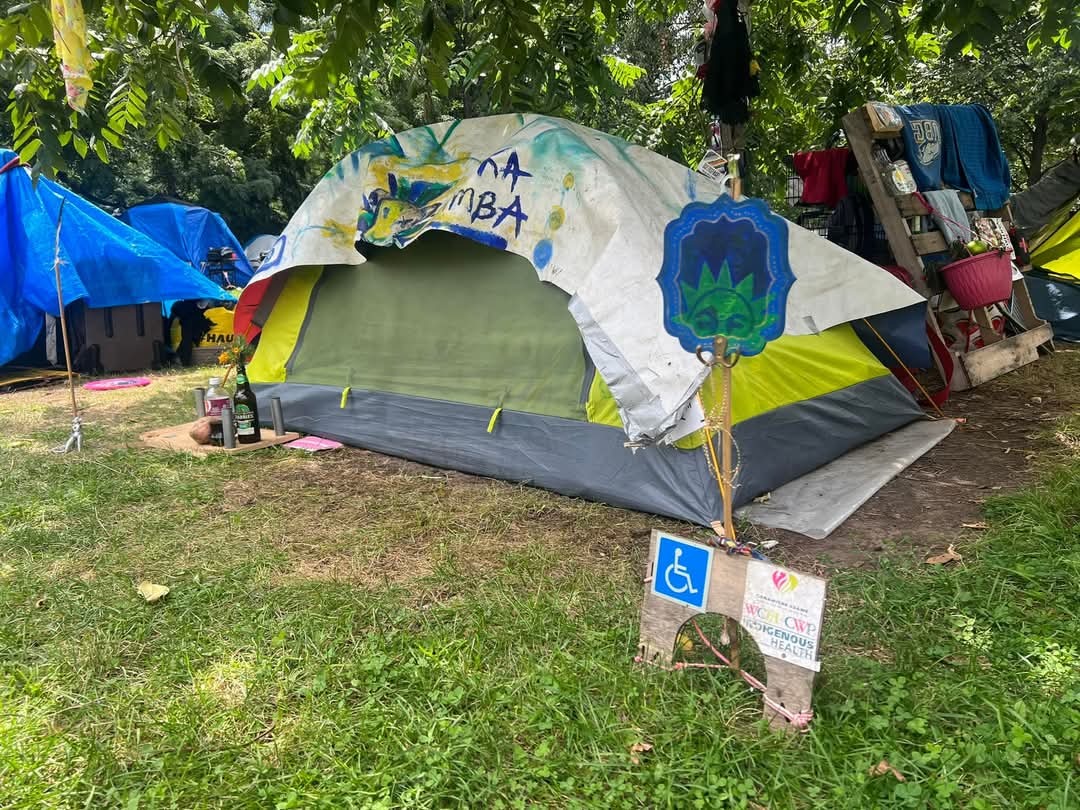
In the summer of 2023, I lived in an encampment at Allan Gardens for three months. Despite finding affordable housing months earlier, the city’s social assistance office kept refusing to disperse funding to support with the first and last month’s rent, so I fell through the cracks.
During this time, I recovered from a lot of violence on my own terms. I sought out student chiropractors and street nurses across the street at Sherbourne Health Centre. Indigenous men and complete strangers showed up with mutual aid and small acts of kindness. The Native Women’s Resource Centre let me participate in an outdoor market, and staff taught me how to jingle dance.
While living in a tent, I finally felt a sense of community, and local activists supported me to create a medical tent for people in the encampment. We dealt with a few overdoses, gave out menstrual pads, provided first aid and clothes. City employees from Streets to Homes even donated medical supplies.
However, through this experience, I saw first hand how police were called when parks employees dismantled tents.
A friend who was working in construction every day had his tent removed while he was at work. One tent resident who was also evicted decided to go live in the forest.
Eventually, I was offered housing by the city right after an assault. As I prepared to move, city staff chose expediency over my personal needs. They refused to give me enough time to deal with my injuries first. They packed up and threw out my belongings, including my tent. It had been providing shelter to two other women. All the trust built by one city team was destroyed by another — and neither took any accountability for causing harm.
The city similarly dismantled camps across different neighbourhoods in the past. In the summer of 2021, the Toronto Police Service cleared the encampment in Alexandra Park. More recently, on Dec 10, 2024, the city cleared the last two tents at Clarence Square Park near Wellington Street and Spadina Avenue after months of safety concerns from nearby residents.
Local advocates, including Maggie Helwig from St. Stephen-in-the-Fields Church in Kensington Market, have spoken up against this approach. Helwig has said on multiple occasions that displacing people from an encampment often results in them joining another one in a few months, if not immediately. In an interview with The Green Line, she said that a harm reduction approach and housing solutions would actually be helpful to address the issue better.
People who have experienced homelessness can still share their experiences on the Federal Housing Advocate's website.



 : Kevin Kenny/Unsplash.



















 : Karen Chan/The Green Line.